Weblog & News
People are always asking us,
"Why do they call it Contra Dancing?"
Is it because it's contrary or country? It may be both! Around 1690, English country dances made their way over to France, where they combined dance steps from both French and English dances. The French called these dances "contredanse," because the men and women started each dance in long paired lines of couples facing each other, as in being contrary.
Tom Steps Out & Gives Debbie A Whirl
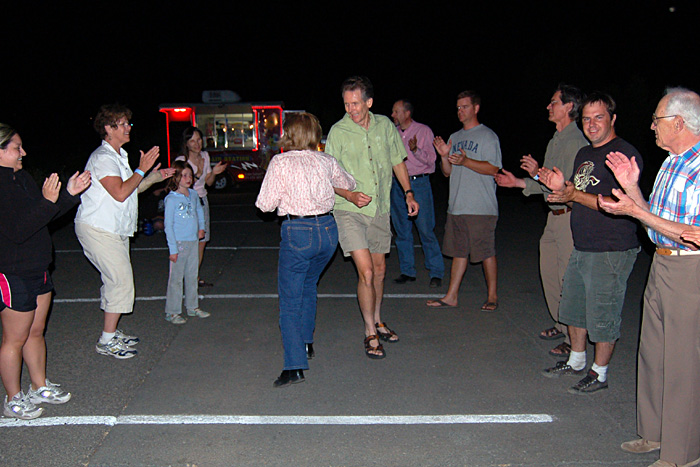
Contra Dancing: A Living Tradition
Today, like back then, contra dancing is done to live music and a caller calls out the moves. Over the course of any particular contra dance, individuals change partners and interact with everyone else in the dance lineup, with everybody traversing patterns. So, contra dancing is a group activity. The music consists of old time tunes that find their roots in Celtic (and therefore Old Time Americana) traditions, including reels, jigs and polkas.
Contra dancing's origins stretch back to the 17th century, when English country dances and French court dances began to merge. The French term "contre-danse" originally referred to dancers standing "opposite" one another, but it also described the blending of English and French styles. These dances were social equalizers: farmers, merchants, and aristocrats all participated, and the emphasis was on cooperation rather than performance.
As these dances crossed the Atlantic, they adapted to the rhythms of American life. Fiddlers in rural communities added syncopation and improvisation, and callers developed a uniquely American role - guiding dancers through figures so that anyone, even newcomers, could join in. This made contra dancing one of the most accessible forms of social dance in early America.
The Sound of Contra: Instruments and Musical Traditions
The music that drives contra dancing has always been central to its energy and appeal. Traditionally, the fiddle has been the star of the contra dance band, carrying the melody with bright, rhythmic bowing rooted in Celtic and Appalachian styles. Alongside the fiddle, other instruments gradually found their place: the mandolin with its crisp tremolo, the accordion with its rich, reedy harmonies, and the piano providing a steady rhythmic backbone.
In New England, the piano became especially important, offering a strong, percussive accompaniment that dancers could feel through the floorboards. In Maritime Canada, the button accordion and fiddle often dominated, giving the music a lively, driving character. Modern contra bands sometimes expand even further, adding guitar, banjo, flute,accordion, bodhran (a round flat drum), or even saxophone. Today, some groups experiment with jazz chords, world rhythms, or electronic effects, yet the core remains the same: lively, danceable tunes that keep the lines moving.
Contra Dancing in Early America
Contra dancing was once popular all over the Western world, especially in New England, Ohio and the Maritime provinces of Canada. Why Ohio? That's where the Western Reserve was established to give land to the veterans of the Revolutionary War. So, America's first vets brought their favorite dancing with them.
In many communities, contra dances served as important social gatherings. They were places where news was exchanged, courtships began, and neighbors strengthened their ties. The communal nature of the dance - changing partners, moving in long lines, and interacting with everyone - reflected the cooperative spirit of rural life.
Contra dances were quite fashionable in the United States until the 1850s, when they got competition from square dances and couples dances, such as waltzes and couples polkas. By the 1930s and '40s, contra dancing was done just in small towns in New England, Maritime Canada and yes still in Ohio, where couples dancing and especially the polka flourished as well.
Revival and Reinvention
The popularity of contra dancing experienced a resurgence in the 1950s and '60s with the folk music revival, and contra dance workshops and music camps sprang up. Then, during the '70's some of the callers began adding new movements, such as "heys" and "gypsies." Becket formation was also introduced, with partners starting out next to each other instead of opposite.
As the revival grew, musicians and callers experimented with new ideas. Bands blended traditional fiddle tunes with jazz, Quebecois rhythms, and even modern improvisational styles. Callers introduced choreography that emphasized flow, connection, and creativity. These innovations helped contra dancing appeal to younger generations while still honoring its roots.
Contra Dancing Today
Today, the urban farming and small farm movement has embraced contra dancing, with more contra dances springing up again at community centers and grange halls. Modern contra communities emphasize inclusivity, often welcoming dancers of all ages, backgrounds, and experience levels. Live bands experiment with everything from traditional tunes to techno-inspired "crossover" contra events.
Despite these innovations, the heart of contra dancing remains the same: joyful movement, shared music, and a sense of belonging. The long lines, the partner changes, and the caller's voice weaving through the music all echo centuries of tradition while continuing to evolve with each new generation of dancers.
Experience It Yourself
To find out more, you'll just have to go experience the fun of contra dancing for yourself!